
Short answer
Start with one gentle, well-studied herb at a time, such as chamomile, ginger or lemon balm, at about 1 to 2 teaspoons of dried herb per cup, once a day for a few days before adding anything else. Infuse leaves and flowers in just-boiled water for 5 to 10 minutes covered, and simmer roots and barks for 15 to 30 minutes. Drink tea away from iron-rich meals, store dried herbs airtight and dark, and check with a clinician first if you are pregnant or take medication.
Key takeaways
- One herb at a time for the first two weeks. If something disagrees with you, you'll know exactly which plant did it.
- Chamomile, ginger and lemon balm are the friendliest first three: mild taste, long food use and actual human research. [1] [2] [3]
- Leaves and flowers get infused (steeped). Roots and barks get decocted (simmered). Getting this right matters more than any fancy gadget.
- A good starting dose is 1 to 2 teaspoons (about 1 to 3 g) of dried herb per 8-ounce cup, once a day.
- Herbal tea drunk with a meal cut iron absorption by 47% to 84% in one study, depending on the herb, so drink it between meals. [4]
- Infusions are best fresh; a decoction batch keeps up to 4 days in a sealed jar in the fridge.
So you bought your first bag of dried herbs. Maybe a friend recommended it, maybe you went down a rabbit hole at 1 a.m. Either way, there it sits on the counter, smelling like a forest, and you have no idea how much to use (sorry, 'a pinch' is not a unit).
Good news: herbal tea is one of the easiest, cheapest and lowest-risk habits in the whole wellness world, as long as you start smart. That means the right first plants, the right brewing method for each plant part, a sensible dose and a short list of people who should check with a clinician first.
By the end of this guide you'll have a kit, three herbs, a brewing method that actually works and a seven-day plan you can start tomorrow morning.
The three rules before your first cup
- One new herb at a time. Give each herb three to five days alone before adding another. Boring? Yes. Smart? Very.
- Start low. A weaker cup you enjoy beats a strong cup you can't stand. You can always go stronger.
- Check your situation first. Pregnant, nursing, on prescription medication, or managing a kidney, liver or bleeding condition? Ask your clinician or pharmacist before starting. That one conversation saves a lot of guessing.
That's it. Those three rules prevent almost every beginner problem we hear about. (Hint: the problem is almost never the plant. It's five plants at once at triple strength.)
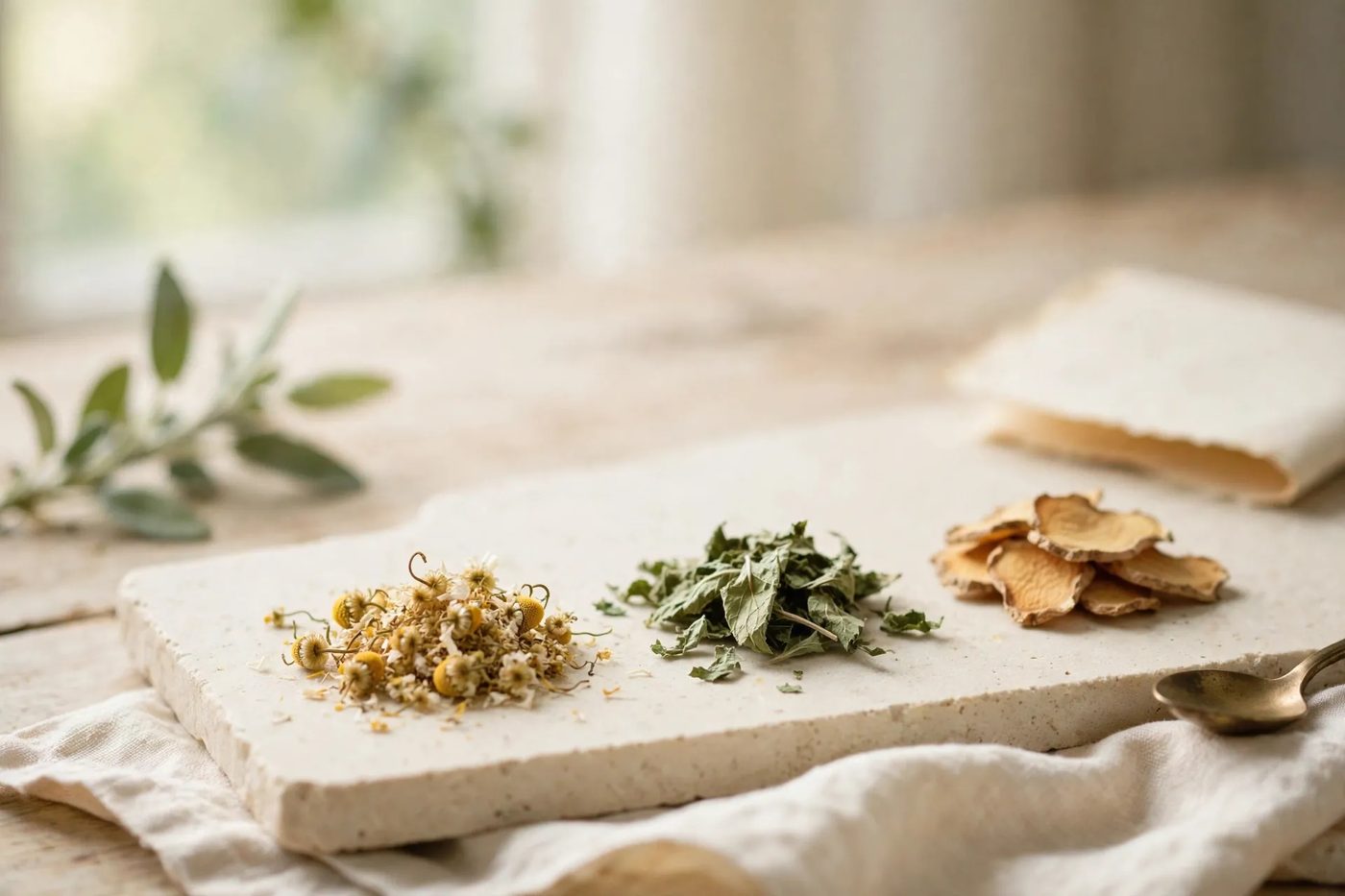
Your first three herbs
We picked these for three reasons: they taste good, they've been used as food and drink for centuries, and each has at least some human research behind it. They also cover both brewing styles, steeping and simmering, so you'll learn the craft as you go.
1. Chamomile (flower): the gentle evening cup
Apple-like, honeyed, calming. Chamomile is traditionally used to support relaxation and a settled stomach. In a small 8-week trial of 57 adults with mild to moderate generalized anxiety, a chamomile extract reduced anxiety scores more than placebo, though the difference was modest and it was an extract, not tea. [1] Brewing chamomile tea pulls out a different mix of compounds than the essential oil does, which is one reason tea and extract results aren't interchangeable. [5]
Who should skip it: people allergic to ragweed, daisies or other plants in the aster family, and anyone on warfarin. There's a published case of serious bleeding in a woman on warfarin who used chamomile tea and lotion. [6]
2. Ginger (root): the warming morning or after-meal cup
Spicy, bright, wakes you up without caffeine. Ginger is traditionally used to support digestion and ease queasiness, and it's one of the better-studied culinary herbs. A meta-analysis of six placebo-controlled trials (508 women) found about 1 g of ginger a day made improvement in early-pregnancy nausea about five times more likely, though the authors noted its safety profile in pregnancy wasn't fully settled. [2]
Who should be careful: anyone on blood thinners should ask a pharmacist. In one small study, ginger didn't change clotting measures or warfarin levels in healthy men, which is reassuring but not a green light for everyone. [7] If you're pregnant, talk to your midwife or doctor before using it as more than a food spice.
3. Lemon balm (leaf): the afternoon reset
Lemony, soft, a bit minty. Lemon balm is a mint-family leaf traditionally used to support calm and focus. In a small crossover trial of 18 volunteers, a 600 mg extract improved self-rated calmness during a stress test, and 300 mg sped up math processing without hurting accuracy. [3] Small study, extract, short term, but a nice signal for a pleasant leaf. Our lemon balm guide has the full file.
Who should be careful: people with thyroid conditions or on sedative medication should ask their clinician first.
| Herb | Part | Method | Starting amount | Steep or simmer | Best time |
|---|---|---|---|---|---|
| Chamomile | Flower | Infusion | 1 to 2 tsp per cup | 5 to 10 min covered | Evening |
| Ginger (dried) | Root | Short decoction | 1 tsp per cup | Simmer 10 to 15 min | Morning or after meals |
| Lemon balm | Leaf | Infusion | 1 to 2 tsp per cup | 5 to 10 min covered | Afternoon |
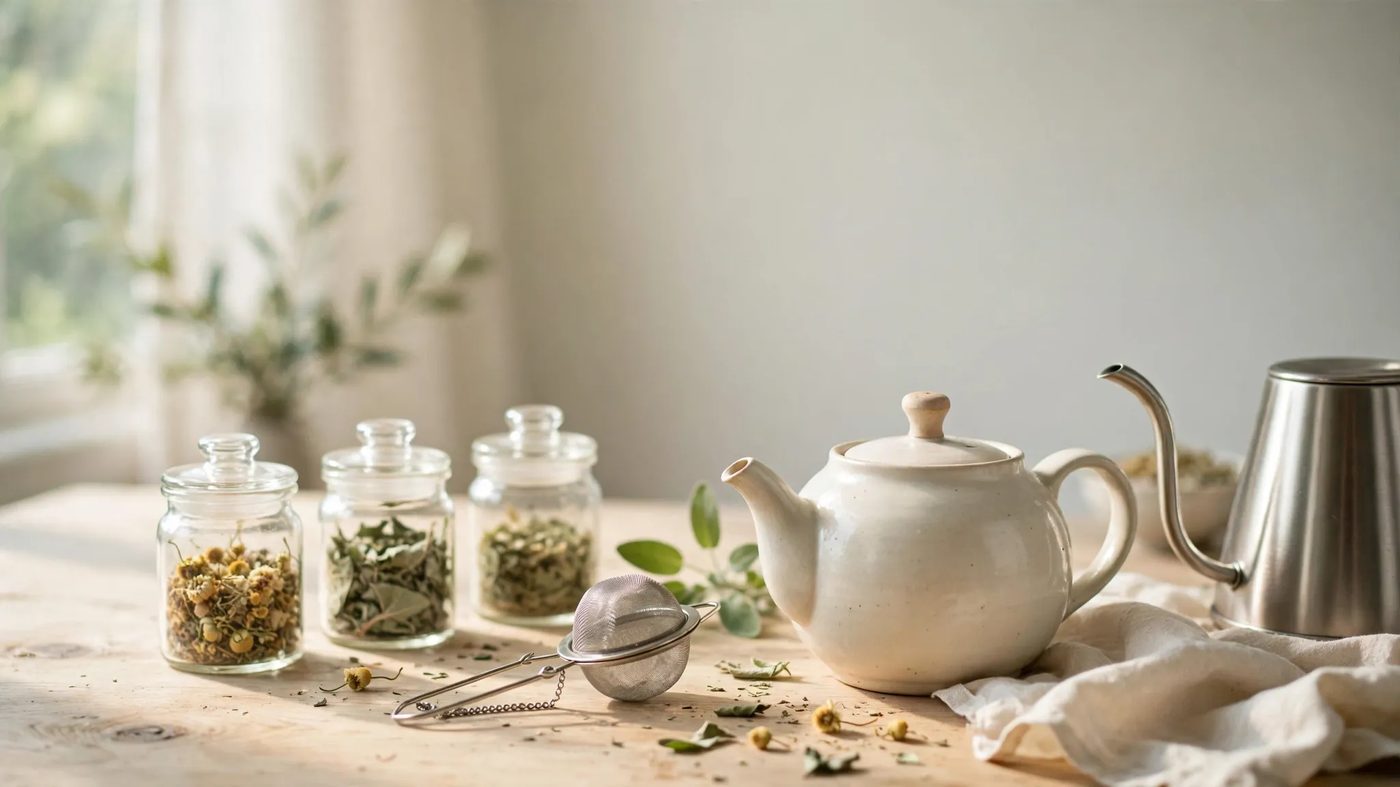
The beginner kit (it costs less than you think)
You don't need a $90 glass gooseneck. Here's what actually earns its spot:
- A kettle or small saucepan. The saucepan does double duty for simmering roots and barks.
- A fine-mesh strainer or a large infuser basket. Tiny tea balls cram the herbs and give weak tea.
- A mug with a lid, or a saucer to cover it. Covering keeps aromatic oils in the cup instead of the air.
- Measuring spoons. Teaspoon and tablespoon. Your eyes lie, spoons don't.
- A timer. Your phone is fine.
- A few glass jars with lids for storing herbs and batch-brewed tea.
- A notebook or notes app to log herb, amount, time and how you felt. Sounds nerdy, works brilliantly.
- Optional: a small kitchen scale for grams, and a quart jar for overnight cold brews.
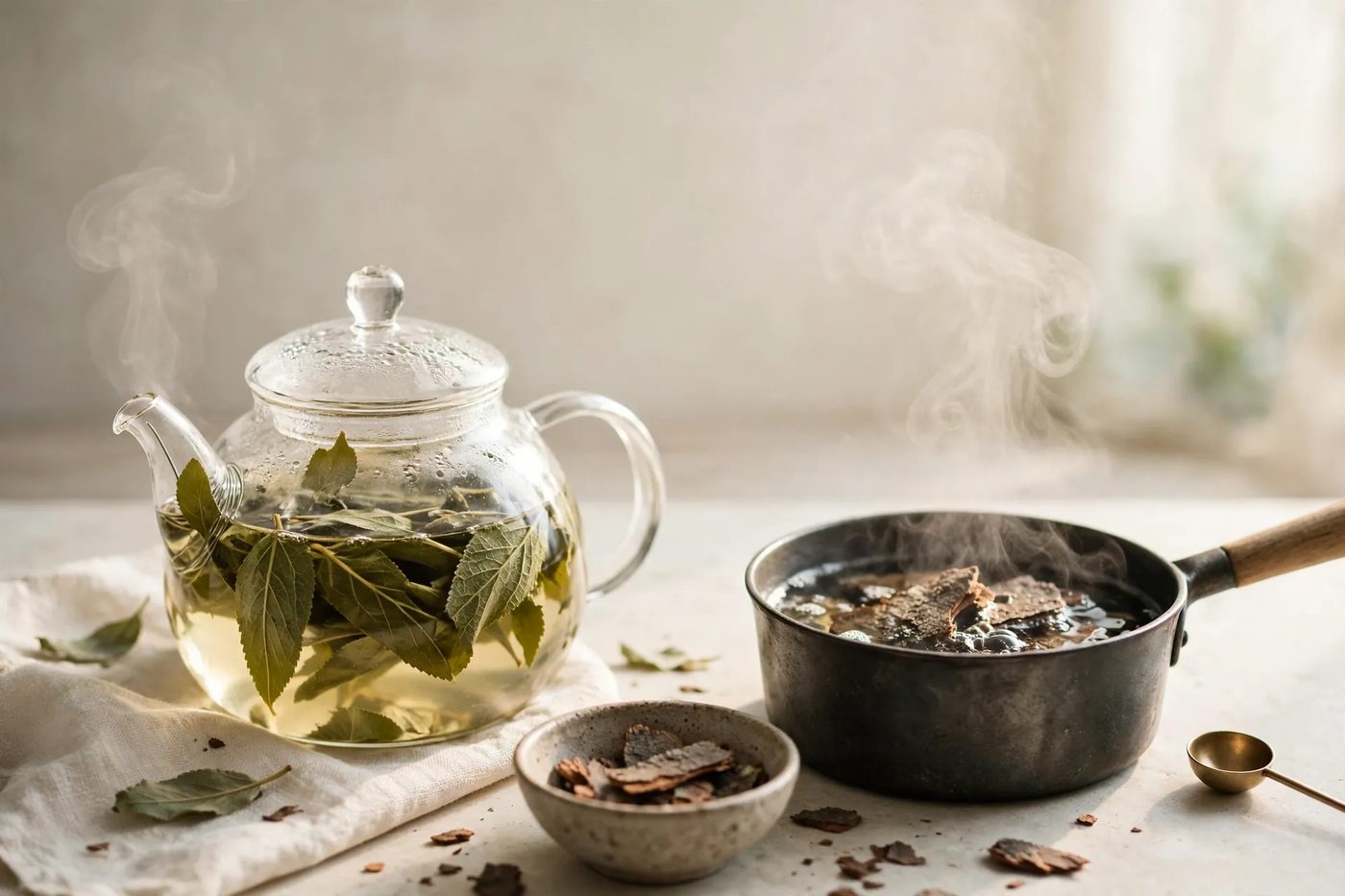
Infusion vs decoction: the one technical thing to learn
Soft plant parts give up their goodness easily. Tough parts don't. That's the whole idea.
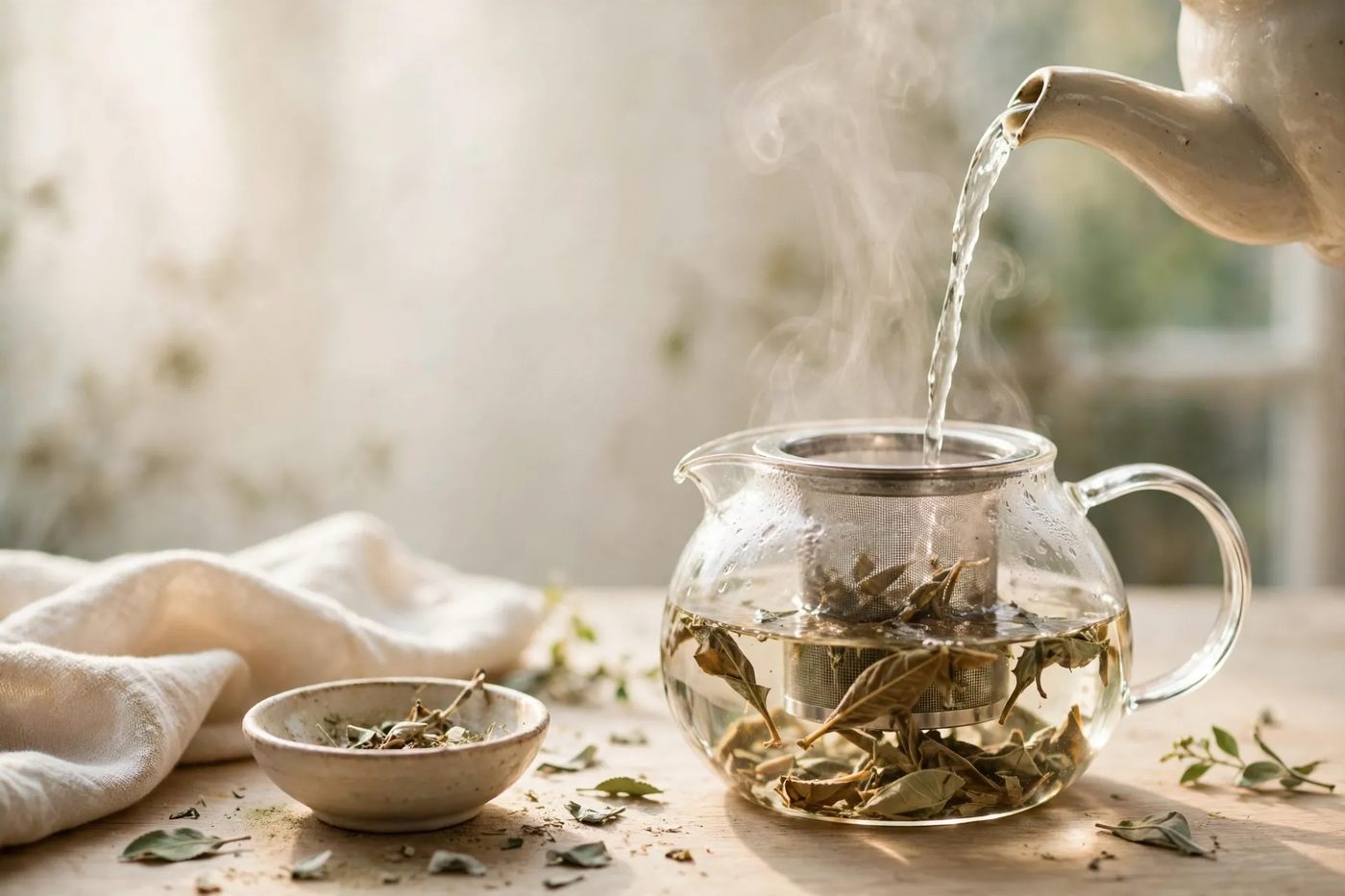
- Infusion (leaves, flowers, soft seeds): pour just-boiled water over the herb, cover, wait 5 to 10 minutes (up to 15 for stronger cups), strain.
- Decoction (roots, barks, hard seeds, dried berries): put the herb in cold water, bring to a boil, lower to a gentle simmer, cover and simmer 15 to 30 minutes, strain.
Time and temperature genuinely change what ends up in the cup. Studies on tea show longer brewing pulls out more of compounds like caffeine and polyphenols, and that particle size and even tea-bag material matter. [8] [9] Even your tap water plays a role: hard, alkaline water reduced catechins in green tea infusions. [10] If your tea tastes flat, try filtered water before blaming the herb.
Full method, with mistakes to avoid, in infusion vs decoction. Exact times by plant in how long to steep herbal tea.
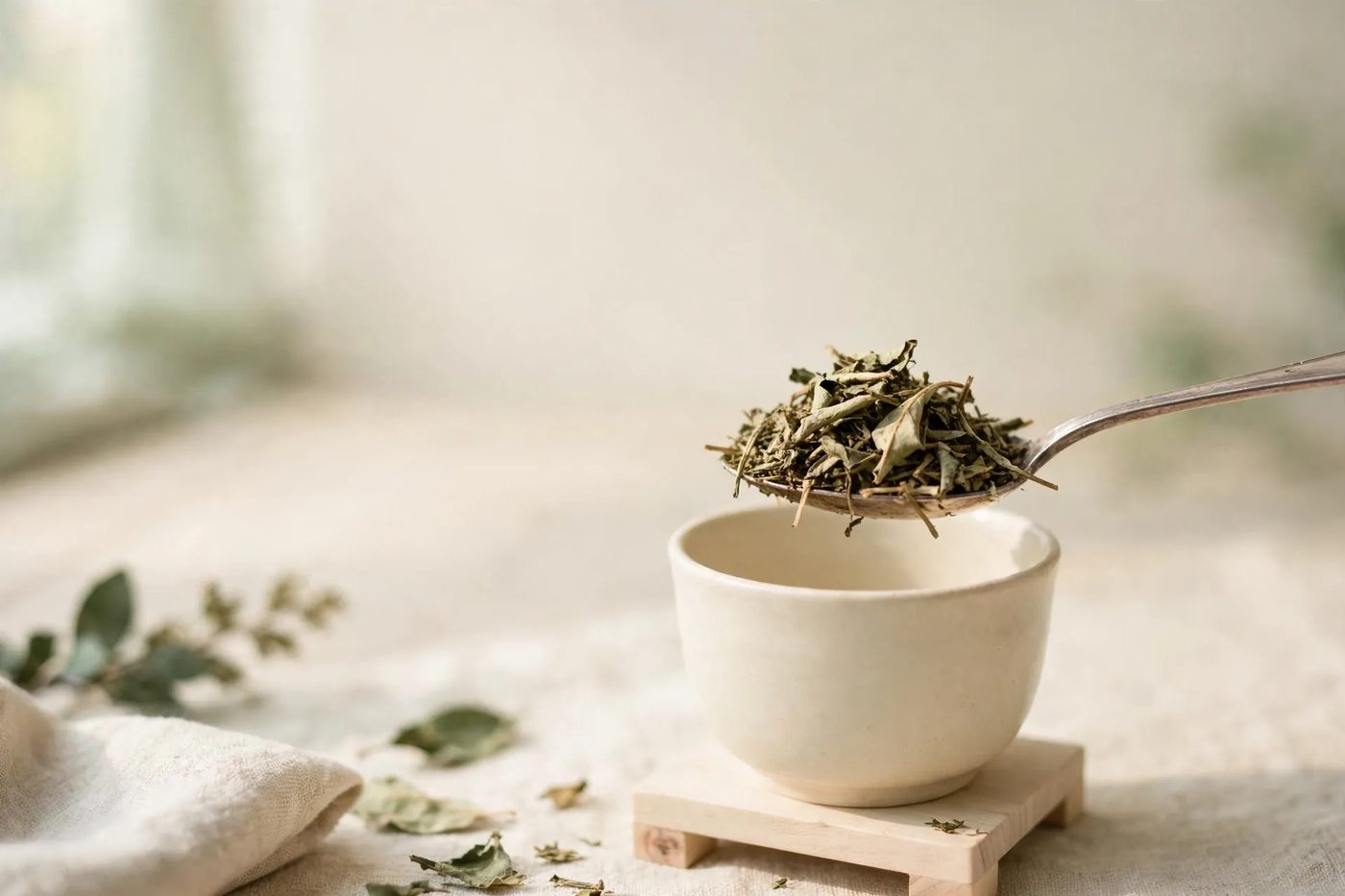
Dosing: how much herb, how often
Let's be concrete. These are cautious starting points for gentle culinary herbs, not prescriptions.
| Situation | Amount | Notes |
|---|---|---|
| Single cup, leaf or flower | 1 to 2 tsp dried (about 1 to 3 g) per 8 oz water | Fluffy flowers need more volume than dense leaves |
| Single cup, root or bark | 1 tsp dried per 8 oz water, simmered | Dense material, so a little goes further |
| Our label style | 1 heaping tbsp per 2 cups of water | Roughly the same ratio, made as a two-cup pot |
| How often, week one | 1 cup a day | Note how you feel |
| How often, after week one | 1 to 3 cups a day of a gentle herb | Take a break every few weeks if using daily |
Stronger isn't better. Doubling the herb doubles the chance of an upset stomach long before it doubles any benefit. And remember timing: in one study, polyphenol-rich drinks cut iron absorption from a bread meal by 47% (chamomile) up to 94% (strong black tea), with lime flower at 52% and peppermint at 84%. [4] If you're vegetarian, vegan or prone to low iron, drink tea at least an hour away from main meals.
Re-steeping and batch brewing
Can you re-steep herbs?
Often, yes. Whole leaves and flowers usually give a decent second cup if you steep it a few minutes longer than the first. The second cup is lighter, so don't expect a repeat performance. Roots and barks can often be simmered a second time for a milder batch. Re-steep the same day. Dried plants already carry a natural microbial load, [13] and a warm, wet pile of spent leaves left overnight gives it a head start.
How to batch brew
Batch brewing is how busy people actually keep a tea habit. It works best with roots and barks.
- Bring 5 cups of water to a boil.
- Add 1/4 cup of dried root or bark.
- Lower to a gentle simmer, cover and simmer 30 minutes.
- Strain into a clean glass jar, cool, lid and refrigerate.
- Drink within 4 days. Warm a cup gently or drink it cold.
That's the exact big-batch method on our root and bark labels. For leaf teas, make a two-cup pot in the morning and finish it that day, or cold brew: 2 tablespoons of leaf in a quart of cold water in the fridge overnight, strained in the morning.
Storage: keep your herbs worth drinking
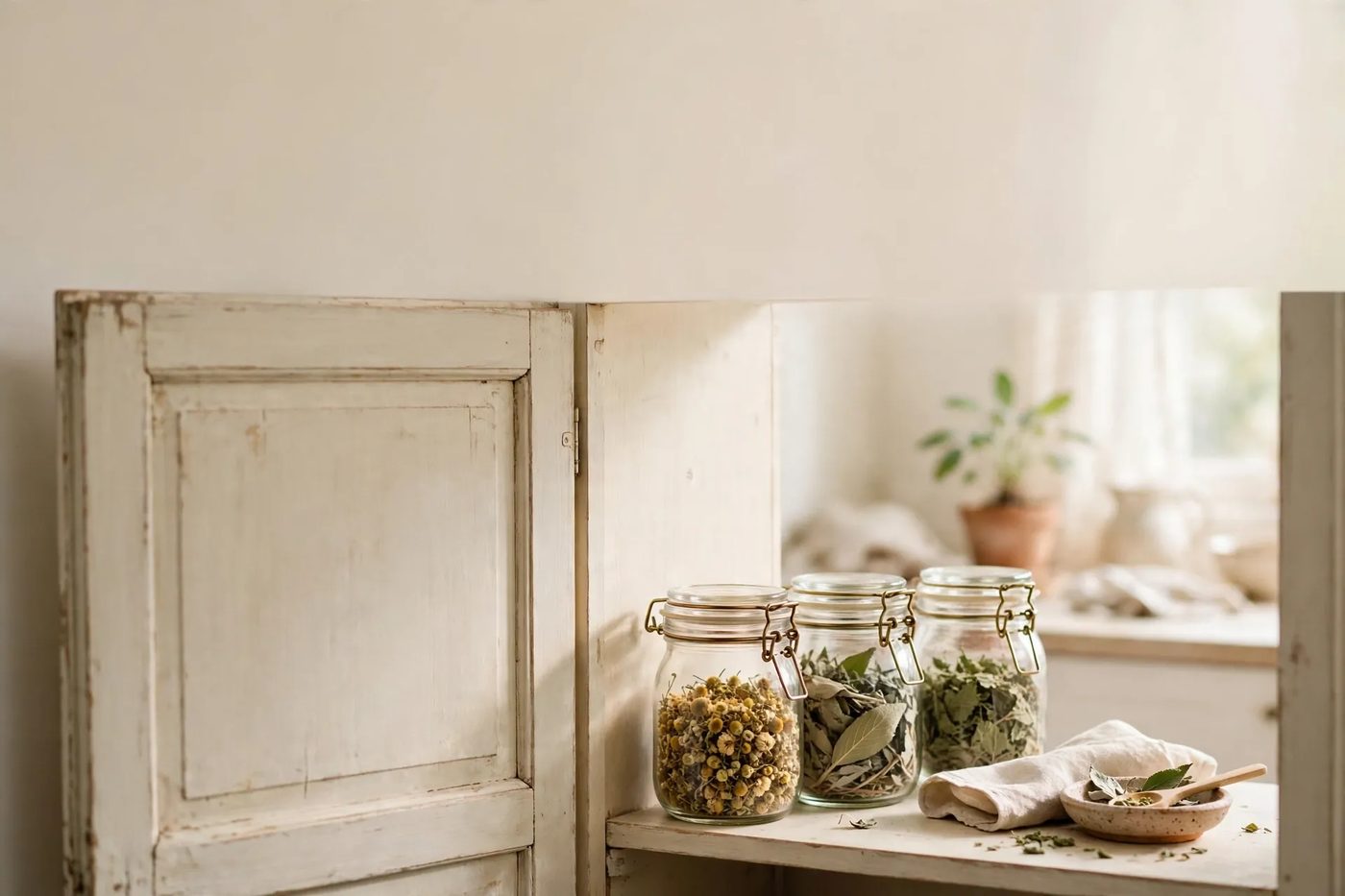
- Airtight: a glass jar or a resealable pouch with the air pressed out.
- Dark: light fades color, aroma and flavor. Cupboard, not windowsill. (Sorry, Instagram shelfie.)
- Cool and dry: away from the stove, kettle steam and sink.
- Labeled and dated: herb name, date opened.
- Shelf life: leaves and flowers are best within about a year; roots and barks often keep longer.
- Brewed tea: infusions are best fresh and within about a day in the fridge; decoctions up to 4 days sealed in the fridge.
- Toss anything musty, damp, clumped or showing mold.
Your week-one plan
Here's the plan. Seven days, two herbs, one notebook. You'll finish the week knowing more about how plants affect you than most people learn in a year of random tea.
| Day | What to do | Why |
|---|---|---|
| 1 | Chamomile, 1 tsp in 8 oz, 5 min covered, after dinner | Gentle start, learn the infusion |
| 2 | Same cup; note sleep and digestion | Build a baseline |
| 3 | Chamomile, 2 tsp, 10 min if day 1 to 2 felt fine | Find your strength |
| 4 | Add nothing new. Repeat your favorite strength | Patience is the method |
| 5 | Start ginger in the morning: 1 tsp dried, simmer 10 min | Learn the decoction |
| 6 | Ginger morning, chamomile evening | Two herbs, different times, no overlap |
| 7 | Review your notes. Keep what you liked; drop what you didn't | Decide week two: try lemon balm next |
In week two, swap in lemon balm for afternoons. When you're ready to combine herbs, read our guide on how to combine herbs safely first.
When you're ready to explore further
Once the basics feel easy, the world of traditional South American herbs opens up. Two good next steps from our shelf: Guayusa, a caffeinated Amazonian holly leaf for mornings, and Scales of Balance, an evening blend of valerian, lemon balm and ajo de monte. Both are traditionally used, both have cautions on their pages, and neither treats anything. Buy any herb, from anyone, using our safe buying checklist.


Signs to stop and check in
- Rash, itching, swelling of lips or throat, or wheezing: stop and get help immediately if severe.
- New stomach pain, diarrhea or nausea that doesn't settle within a day of stopping.
- Unusual bruising or bleeding, especially if you take blood thinners.
- Racing heart, jitters or poor sleep (usually caffeine).
- Any symptom you were hoping the tea would fix that gets worse or lasts. That needs a clinician, not a stronger cup.
Frequently asked questions
What herbs should a beginner start with?
Chamomile, ginger and lemon balm are friendly first choices: mild flavor, long food use and some human research. Try one at a time for three to five days before adding the next.
How much dried herb per cup of tea?
About 1 to 2 teaspoons (roughly 1 to 3 g) of dried leaf or flower per 8-ounce cup, or about 1 teaspoon of dried root or bark. Our labels use 1 heaping tablespoon per 2 cups of water, which works out about the same.
What is the difference between infusion and decoction?
An infusion steeps soft parts like leaves and flowers in just-boiled water for 5 to 15 minutes. A decoction simmers tough parts like roots and barks for 15 to 30 minutes to extract them properly.
Can you re-steep herbal tea?
Usually yes, once, the same day. Steep the second cup a little longer, and expect it to be lighter. Do not leave wet herbs sitting for days.
How long does brewed herbal tea last in the fridge?
Infusions are best within about a day. Decoctions made as a batch keep up to 4 days in a sealed glass jar in the fridge.
Is it safe to drink herbal tea every day?
For most healthy adults, 1 to 3 cups a day of a gentle herb is reasonable. Drink it away from iron-rich meals, take breaks from daily use every few weeks, and check with a clinician if you are pregnant or take medication.
How should I store dried herbs?
In an airtight container, somewhere cool, dark and dry, labeled with the date. Use leaves and flowers within about a year; roots and barks often keep longer.
References
- Amsterdam JD, Li Y, Soeller I, Rockwell K, Mao JJ, Shults J, et al. (2009). A randomized, double-blind, placebo-controlled trial of oral Matricaria recutita (chamomile) extract therapy for generalized anxiety disorder. Journal of clinical psychopharmacology. PubMed 19593179 · DOI
- Thomson M, Corbin R, Leung L (2014). Effects of ginger for nausea and vomiting in early pregnancy: a meta-analysis. J Am Board Fam Med. PubMed 24390893 · DOI
- Kennedy DO, Little W, Scholey AB (2004). Attenuation of laboratory-induced stress in humans after acute administration of Melissa officinalis (Lemon Balm). Psychosom Med. PubMed 15272110 · DOI
- Hurrell RF, Reddy M, Cook JD (1999). Inhibition of non-haem iron absorption in man by polyphenolic-containing beverages. Br J Nutr. PubMed 10999016
- Tschiggerl C, Bucar F (2012). Guaianolides and volatile compounds in chamomile tea. Plant Foods Hum Nutr. PubMed 22410959 · DOI
- Segal R, Pilote L (2006). Warfarin interaction with Matricaria chamomilla. CMAJ. PubMed 16636327 · DOI
- Jiang X, Williams KM, Liauw WS, Ammit AJ, Roufogalis BD, Duke CC, et al. (2005). Effect of ginkgo and ginger on the pharmacokinetics and pharmacodynamics of warfarin in healthy subjects. British journal of clinical pharmacology. PubMed 15801937 · DOI
- Astill C, Birch MR, Dacombe C, Humphrey PG, Martin PT, et al. (2001). Factors affecting the caffeine and polyphenol contents of black and green tea infusions. J Agric Food Chem. PubMed 11714326 · DOI
- Ayakdaş G, Ağagündüz D (2025). Determination of L-Theanine and Caffeine Contents in Tea Infusions with Different Fermentation Degrees and Brewing Conditions Using the Chromatographic Method. Foods. PubMed 40647065 · DOI
- Cabrera M, Taher F, Llantada A, Do Q, Sapp T, Sommerhalter M, et al. (2021). Effect of Water Hardness on Catechin and Caffeine Content in Green Tea Infusions. Molecules. PubMed 34201178 · DOI
- Wikoff D, Welsh BT, Henderson R, Brorby GP, Britt J, Myers E, et al. (2017). Systematic review of the potential adverse effects of caffeine consumption in healthy adults, pregnant women, adolescents, and children. Food Chem Toxicol. PubMed 28438661 · DOI
- Drake C, Roehrs T, Shambroom J, Roth T, et al. (2013). Caffeine effects on sleep taken 0, 3, or 6 hours before going to bed. J Clin Sleep Med. PubMed 24235903 · DOI
- Kneifel W, Czech E, Kopp B (2002). Microbial contamination of medicinal plants--a review. Planta Med. PubMed 11842319 · DOI