
Short answer
Yes, most healthy adults can mix guayusa and cat's claw in one tea: we found no study showing they interact with each other, and they brew well together if you simmer the bark first and steep the leaf off the heat. The cautions simply add up: guayusa brings caffeine, and cat's claw is a poor fit in pregnancy, kidney or autoimmune conditions, or with several medications. The general rule for blending is to avoid stacking herbs with the same strong action, like two caffeine sources or several sedatives.
Key takeaways
- Guayusa plus cat's claw: no known herb-to-herb clash, but nobody has studied the pair. Brew the bark as a decoction, then infuse the leaf in the hot liquid off the heat.
- The real danger in blending is stacking, not mixing: two caffeine herbs, or sedative herbs plus alcohol or sleep medication. [1] [2]
- More is not always better even within a classic pair: a valerian and lemon balm product eased stress-test anxiety at 600 mg but raised it slightly at 1,800 mg. [3]
- Medication is the bigger interaction risk than herb-to-herb. Of human studies on herbs widely used in Ecuador, about a third reported clinically relevant drug interactions. [4]
- Good blends use a base herb, one or two supporting herbs and a small accent, at roughly 60 / 30 / 10.
- Use caffeine herbs in the morning and calming herbs in the evening, and keep any tea an hour away from iron-rich meals. [5]
We get this exact question in our inbox more than almost any other: 'Can I put guayusa and cat's claw in the same pot?' Usually followed by 'and maybe some ginger, and what about the valerian, and is it bad if I also have coffee?'
Blending herbs is one of the oldest things people do with plants. Most traditional teas are blends. The trouble isn't mixing; it's piling up herbs that do the same strong thing, or forgetting that the tea has to share your body with your medication (and your third espresso).
Below: the straight answer on guayusa and cat's claw, five blending rules, a table of pairings that work and ones to skip, how to make blends taste good, and a morning-to-night routine you can actually follow.
Can you mix guayusa and cat's claw in one tea?
Short answer: for most healthy adults, yes. Long answer, because you deserve it:
- No study tests the pair. We found no research on guayusa and cat's claw together, so nobody can promise a combined effect. Anyone who tells you the combo 'synergizes' is guessing. (Confidently, sure. Still guessing.)
- No obvious clash. Guayusa's main active is caffeine, plus theobromine. [6] Cat's claw is a bark with oxindole alkaloids and has shown drug-transporter effects in lab work, [7] but there's no known pathway where one makes the other dangerous.
- The cautions add together. You inherit both lists. Guayusa: caffeine limits, sleep, pregnancy, anxiety, heart rhythm issues. Cat's claw: pregnancy, autoimmune conditions, transplant medication, kidney problems (there's a case report of kidney inflammation), Parkinson's disease (a case of worsening symptoms), and multiple medications. [8] [9]
In two small trials, guayusa extracts (not tea) improved mood, perceived energy and reaction speed within one to two hours. Jitteriness rose with dose in women, and both trials saw blood pressure tick up by a few points. [10] [11] Drink that at 9 p.m. and you'll find out about it at 3 a.m.
How to brew them together
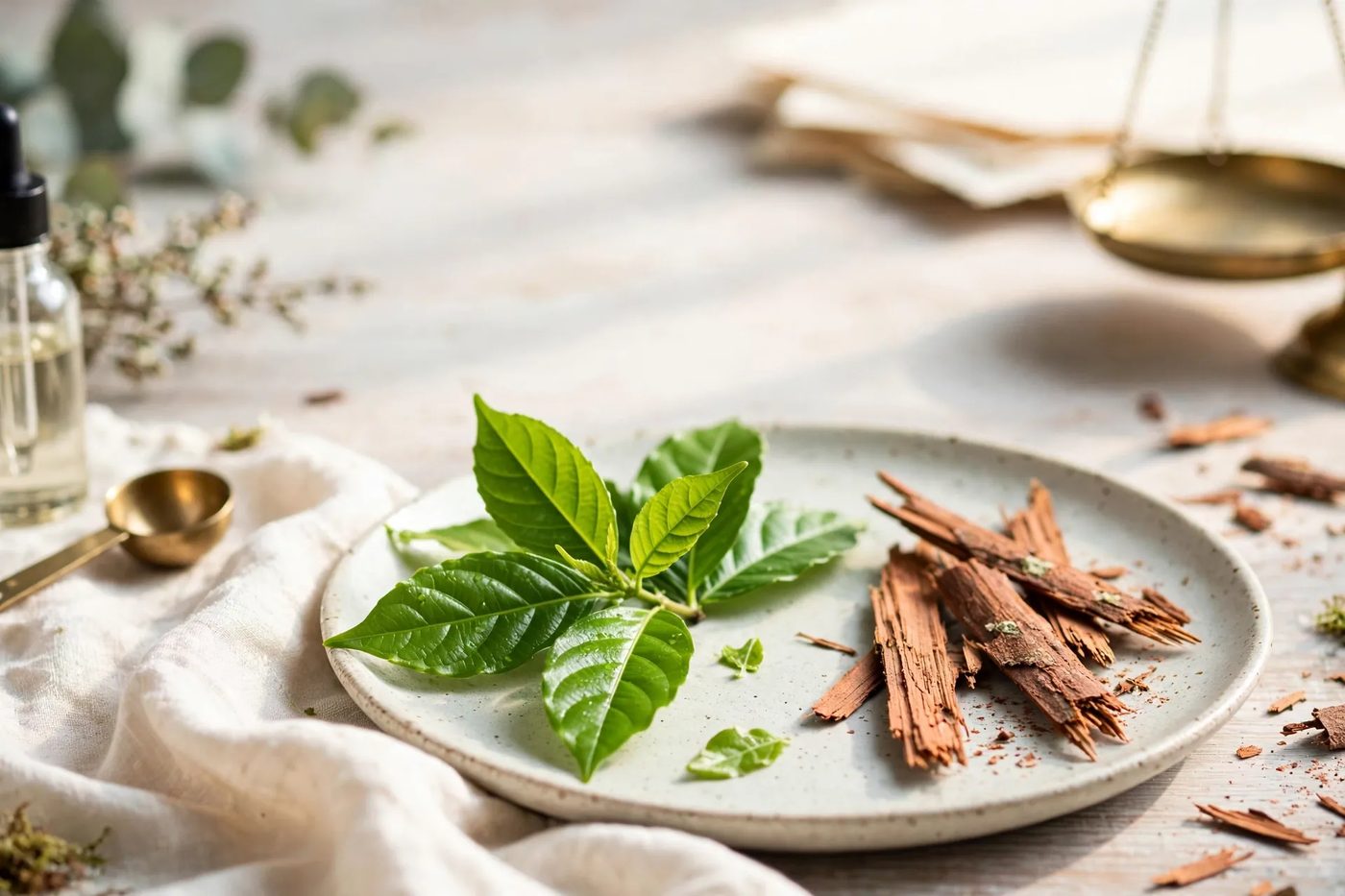
- Simmer 1 tablespoon of cat's claw bark in 2 1/2 cups of water, covered, for 30 minutes. Bark needs the decoction.
- Turn off the heat. Add 1 heaping teaspoon to 1 tablespoon of guayusa leaf.
- Cover and steep 5 to 7 minutes. Leaf needs only an infusion; boiling it for 30 minutes makes it harsh.
- Strain and drink before noon. Makes about 2 cups.
Taste-wise, cat's claw is woody and bitter, guayusa is smooth and slightly sweet, so they balance nicely. A slice of ginger or a few stevia leaves rounds it out. Our Guayusa and Cat's Claw are both wild-harvested in Ecuador and sold whole, so you can measure each one yourself instead of trusting a premixed ratio.
The five rules of safe blending
- Learn each herb alone first. Try every herb solo for a few days before blending it. If a blend upsets you, you'll know the suspect.
- Don't stack strong actions. One caffeine herb per cup. One or two gentle calming herbs, never three plus a sleeping pill. One stimulant laxative, never two.
- Respect the plant part. Roots and barks need simmering; leaves and flowers need steeping. Blend in that order. (See infusion vs decoction.)
- Keep blends small. Three or four herbs is plenty. Ten-herb 'everything' teas make it impossible to know what's working or what's bothering you.
- Check medication interactions for every herb in the blend, not just the headline one. A blend is as cautious as its most cautious ingredient.
Mixing herbs is ancient. Stacking herbs that do the same strong thing is how people get into trouble.
Stacking caffeine: the most common mistake
Guayusa, yerba mate, green tea, black tea, coffee, cacao and many 'energy' blends all contain caffeine. Mix guayusa and mate in one cup and then have a coffee, and you've had three caffeine sources before lunch without noticing. (Your heart noticed.)
- The ceiling: a large systematic review found up to about 400 mg of caffeine a day generally not linked to adverse effects in healthy adults, and up to about 300 mg in pregnancy. [12] Those are limits from all sources combined.
- The sleep cutoff: a meta-analysis of 24 studies found caffeine cut total sleep by about 45 minutes and suggested a cup of coffee be finished at least 8.8 hours before bed. [1] A home study found 400 mg even 6 hours before bed disrupted sleep. [13]
- Why tea can feel gentler than coffee: in a crossover trial, caffeine plus L-theanine (an amino acid in true tea) improved more attention and memory measures than caffeine alone, and the authors concluded the pair behaves differently from caffeine on its own. [14] Guayusa has not been tested that way, so don't assume it behaves like green tea.
Practical rule: one caffeinated herb per day-part, all caffeine before about 1 p.m. if you sleep around 10, and count every source.
Stacking sedatives: where it gets serious
Valerian, lemon balm, chamomile, passionflower and hops are all traditionally used to support relaxation and sleep. Gentle on their own. The issue is piling them up, or adding them to alcohol, cannabis, antihistamines or prescription sleep and anxiety drugs.
- Benzodiazepines and related sedatives already carry real risks of dependence and overdose, especially combined with other depressants. [2] Don't add sedative herbs on top without your prescriber's input.
- The valerian and lemon balm lesson: in a crossover trial of 24 volunteers, a combined product at 600 mg reduced anxiety during a stress test, but 1,800 mg slightly increased anxiety. [3] More is not more.
- Valerian's track record: a meta-analysis of 16 trials found a possible benefit for sleep quality with high variation and possible publication bias. [15] Reassuringly, valerian did not change key liver drug-processing enzymes in a human study, and a review found no clinically relevant interactions. [16] [17] That's about valerian alone, not valerian stacked with five other things.
- Lemon balm on its own improved calmness at 600 mg in a small stress-test trial. [18]
Practical rule: pick one or two calming herbs for the evening, no alcohol in the same evening, never with prescription sleep or anxiety medication unless your prescriber says so, and don't drive after a strong sedative tea.
Herb plus medication: the interaction that matters more
Herb-to-herb clashes in tea amounts are rarely reported. Herb-to-drug interactions are not. A systematic review of human studies on medicinal plants widely used in Ecuador found clinically relevant interactions in 31.9% of included studies, most often lower drug levels or a higher bleeding risk. [4] A US review sorted common supplements into those to avoid with most medications (like St John's wort and goldenseal), those that interact with a few drugs, and low-risk ones like valerian. [19]
- Blood thinners: chamomile has a published case of serious bleeding with warfarin. [20] Ask before using any herb regularly.
- Cat's claw: lab evidence of effects on drug transporters, so check with a pharmacist if you take several medications. [7]
- Diabetes, blood pressure, thyroid, immune-suppressing and seizure medicines: always ask first.
- Iron: in one study, herbal teas drunk with a meal cut iron absorption by 47% (chamomile) to 84% (peppermint). [5] Space tea and iron-rich meals or iron supplements by an hour or more.
Good and bad pairings at a glance
Our working table. 'Good' means traditional, compatible and sensible in tea amounts for healthy adults, not proven to boost each other. 'Skip' means the combined effect stacks in a way we wouldn't recommend.
| Pairing | Verdict | Why |
|---|---|---|
| Guayusa + cat's claw | Good (morning) | No known clash; simmer bark, steep leaf; both caution lists apply |
| Guayusa + ginger | Good (morning) | Warming, smooth; one caffeine source |
| Guayusa + stevia leaf | Good | Sweetens without sugar |
| Guayusa + yerba mate or coffee | Skip | Stacked caffeine [12] |
| Ginger + fennel | Good (after meals) | Classic digestive pairing; both culinary |
| Chamomile + lemon balm | Good (evening) | Gentle, pleasant; skip chamomile on warfarin [20] |
| Valerian + lemon balm | Good at moderate amounts | Studied combination; higher doses backfired [3] |
| Valerian + alcohol or sleep medication | Skip | Stacked sedation [2] |
| Three or more sedative herbs | Skip | Hard to judge; more is not better |
| Senna + another laxative herb | Skip | Stacked laxative effect; cramps and dehydration |
| Cat's claw + soursop leaf | Caution | Both have reports linking them to worse Parkinson's symptoms [9] [21]; cat's claw adds kidney and immune cautions. Not a casual daily blend |
| Any herbal tea + iron-rich meal | Space apart | Lower iron absorption [5] |
Flavor balancing: making blends taste good
Safety handled, now the fun part. A blend you love is a blend you'll actually drink.
The 60 / 30 / 10 rule
- Base (about 60%): the main herb and the reason for the cup. Guayusa in the morning, chamomile at night.
- Support (about 30%): something that rounds out the base. Ginger warms, fennel sweetens, lemon balm brightens.
- Accent (about 10%): a small, strong flavor. A few stevia leaves, a pinch of cinnamon, a strip of citrus peel.
Flavor families
| Flavor | Herbs | Balance it with |
|---|---|---|
| Bitter, woody | Cat's claw, valerian, chuchuhuasi | Sweet (stevia leaf, cinnamon) or bright (lemon balm, citrus peel) |
| Grassy, green | Guayusa, nettle | Warm (ginger) or floral (chamomile) |
| Floral, honeyed | Chamomile, linden | A little citrus or mint for lift |
| Spicy, warming | Ginger, cinnamon | Sweet or soft (fennel, licorice in small amounts) |
| Earthy, musky | Valerian | Strong aromatics (lemon balm, mint); honestly, valerian always wins |
Two technique tips. Add aromatic leaves at the end of a decoction so their oils don't boil off. And blend by weight or level spoons, then write down the ratio. Future you will want to remake the good one. (Past you never writes it down.)
A morning-to-night herbal tea routine
Here's a full day that respects caffeine timing, keeps calming herbs for the evening and spaces tea from meals. Treat it as a template, and drop any herb that doesn't suit you or your medications.
| Time | Cup | How to brew | Why this slot |
|---|---|---|---|
| 7 a.m. | Guayusa, or guayusa + cat's claw | Simmer bark 30 min, steep leaf 5 to 7 min off heat | Caffeine early, long before bed [1] |
| 8 a.m. | Breakfast, water or nothing | n/a | Keep tea an hour from iron-rich meals [5] |
| 10:30 a.m. | Ginger, plain or with a little guayusa | Simmer ginger 10 min | Warm and steady; caffeine still early |
| 1 p.m. | Lunch | n/a | Caffeine cutoff for a 10 p.m. bedtime |
| 3 p.m. | Lemon balm, or ginger with fennel | Steep 5 to 10 min covered | Afternoon reset with no caffeine |
| 6:30 p.m. | Dinner | n/a | Space tea from the meal |
| 8:30 p.m. | Chamomile, or one evening blend such as Scales of Balance | Steep 10 to 15 min covered | Calming herbs only, no alcohol, no other sedatives |
That's up to five cups, which is a lot for a beginner. Start with two slots (morning and evening) and add more only if you enjoy them. If you're new to all of this, start with our beginner's guide to herbal tea.
 GuayusaEnergy + Clarity$22.50 · 2oz
 Cat's ClawImmune support + Joint comfort + Cellular wellness$22.50 · 2oz
 Scales of BalanceNervous System Calm + Sleep Support$28.50 · 2oz
Who should not blend without a clinician
- Pregnant or breastfeeding: skip cat's claw entirely, keep caffeine under about 300 mg a day, and check every herb. [12]
- On blood thinners, diabetes, blood pressure, thyroid, seizure, immune-suppressing or sleep medication. [4]
- Kidney disease or autoimmune conditions: cat's claw in particular. [8]
- Parkinson's disease: cat's claw has a case report of worsening symptoms. [9]
- Heart rhythm problems, anxiety or panic disorder: go easy on caffeine herbs.
- Before surgery: tell your surgical team about every herb you take.
Frequently asked questions
Can I mix guayusa and cat's claw in one tea?
Most healthy adults can. We found no study showing they interact with each other, but nobody has tested the pair either. Simmer the cat's claw bark for 30 minutes, then steep the guayusa leaf off the heat for 5 to 7 minutes, and drink it in the morning. Both herbs' cautions apply, including caffeine limits and cat's claw's warnings for pregnancy, kidney, autoimmune conditions and medication.
Is it safe to mix herbal teas together?
Usually, if you avoid stacking herbs with the same strong action, keep blends to three or four herbs, learn each herb alone first and check medication interactions for every ingredient.
What herbs should not be mixed?
Avoid combining two or more caffeine sources, several sedative herbs together or with alcohol or sleep medication, and more than one stimulant laxative. Herbs with interaction warnings, such as cat's claw or chamomile with warfarin, need a pharmacist's input.
Can you mix valerian and lemon balm?
Yes, it is a classic and studied combination. In one trial a moderate dose reduced stress-test anxiety, while a much higher dose slightly increased it, so keep amounts moderate and do not add alcohol or sleep medication.
Can I drink guayusa with coffee?
It stacks caffeine. Healthy adults are generally fine up to about 400 mg of caffeine a day from all sources, so count both, and finish caffeine early in the day to protect sleep.
How do I blend herbs so they taste good?
Use about 60% of a base herb, 30% supporting herb and 10% accent. Balance bitter herbs with sweet or bright ones, add aromatic leaves at the end of simmering, and write down ratios you like.
What is a good herbal tea routine for the day?
Caffeine herbs like guayusa in the morning, gentle non-caffeinated herbs like ginger or lemon balm in the afternoon, and calming herbs like chamomile in the evening, with tea spaced an hour from iron-rich meals.
References
- Gardiner C, Weakley J, Burke LM, Roach GD, Sargent C, Maniar N, et al. (2023). The effect of caffeine on subsequent sleep: A systematic review and meta-analysis. Sleep Med Rev. PubMed 36870101 · DOI
- Peng L, Morford KL, Levander XA (2022). Benzodiazepines and Related Sedatives. Med Clin North Am. PubMed 34823725 · DOI
- Kennedy DO, Little W, Haskell CF, Scholey AB, et al. (2006). Anxiolytic effects of a combination of Melissa officinalis and Valeriana officinalis during laboratory induced stress. Phytother Res. PubMed 16444660 · DOI
- Zambrano-Villacres R, Montenegro-Acosta W, Rodriguez-Veintimilla D, Rodriguez-Larraburu E, Espro C, Bressi V, et al. (2027). Herb-drug interactions with clinical impact: A systematic review of global clinical evidence on medicinal plants widely used in Ecuador. J Ethnopharmacol. PubMed 42480877 · DOI
- Hurrell RF, Reddy M, Cook JD (1999). Inhibition of non-haem iron absorption in man by polyphenolic-containing beverages. Br J Nutr. PubMed 10999016
- Kapp RW Jr, Mendes O, Roy S, McQuate RS, Kraska R, et al. (2016). General and Genetic Toxicology of Guayusa Concentrate (Ilex guayusa). Int J Toxicol. PubMed 26811391 · DOI
- Szilvásy N, Lajer P, Horváth A, Veres K, Hohmann J, Schelz Z, et al. (2024). Modulation of Multispecific Transporters by Uncaria tomentosa Extract and Its Major Phytoconstituents. Pharmaceutics. PubMed 39598486 · DOI
- Portalatin G, Shettigar S, Carrion-Rodriguez A, Medikayala S, Herlitz L, Sandy D, et al. (2022). Ketogenic-Diet Shake Containing Uncaria tomentosa-Associated Acute Interstitial Nephritis. Case Rep Nephrol Dial. PubMed 36465572 · DOI
- Cosentino C, Torres L (2008). Reversible worsening of Parkinson disease motor symptoms after oral intake of Uncaria tomentosa (cat's claw). Clin Neuropharmacol. PubMed 18836348 · DOI
- Helwig NJ, Schwager LE, Berry AC, Zucker AC, Venenga JS, Sterbenz SC, et al. (2024). Acute, dose-response effects of guayusa leaf extract on mood, cognitive and motor-cognitive performance, and blood pressure, heart rate, and ventricular repolarization. J Int Soc Sports Nutr. PubMed 39014963 · DOI
- La Monica MB, Raub B, Ziegenfuss EJ, Hartshorn S, Grdic J, Gustat A, et al. (2023). Acute Effects of Naturally Occurring Guayusa Tea and Nordic Lion's Mane Extracts on Cognitive Performance. Nutrients. PubMed 38140277 · DOI
- Wikoff D, Welsh BT, Henderson R, Brorby GP, Britt J, Myers E, et al. (2017). Systematic review of the potential adverse effects of caffeine consumption in healthy adults, pregnant women, adolescents, and children. Food Chem Toxicol. PubMed 28438661 · DOI
- Drake C, Roehrs T, Shambroom J, Roth T, et al. (2013). Caffeine effects on sleep taken 0, 3, or 6 hours before going to bed. J Clin Sleep Med. PubMed 24235903 · DOI
- Haskell CF, Kennedy DO, Milne AL, Wesnes KA, Scholey AB, et al. (2008). The effects of L-theanine, caffeine and their combination on cognition and mood. Biol Psychol. PubMed 18006208 · DOI
- Bent S, Padula A, Moore D, Patterson M, Mehling W, et al. (2006). Valerian for sleep: a systematic review and meta-analysis. Am J Med. PubMed 17145239 · DOI
- Gurley BJ, Gardner SF, Hubbard MA, Williams DK, Gentry WB, Khan IA, et al. (2005). In vivo effects of goldenseal, kava kava, black cohosh, and valerian on human cytochrome P450 1A2, 2D6, 2E1, and 3A4/5 phenotypes. Clin Pharmacol Ther. PubMed 15900287 · DOI
- Kelber O, Nieber K, Kraft K (2014). Valerian: no evidence for clinically relevant interactions. Evid Based Complement Alternat Med. PubMed 25093031 · DOI
- Kennedy DO, Little W, Scholey AB (2004). Attenuation of laboratory-induced stress in humans after acute administration of Melissa officinalis (Lemon Balm). Psychosom Med. PubMed 15272110 · DOI
- Asher GN, Corbett AH, Hawke RL (2017). Common Herbal Dietary Supplement-Drug Interactions. Am Fam Physician. PubMed 28762712
- Segal R, Pilote L (2006). Warfarin interaction with Matricaria chamomilla. CMAJ. PubMed 16636327 · DOI
- Cleret de Langavant L, Roze E, Petit A, Tressières B, Gharbi-Meliani A, Chaumont H, et al. (2022). Annonaceae Consumption Worsens Disease Severity and Cognitive Deficits in Degenerative Parkinsonism. Mov Disord. PubMed 36210778 · DOI